LeWorldModel: A Compact Latent World Model—and Where It Breaks
A guide to LeWorldModel’s action-conditioned JEPA, its planning interface, its design choices, and the limits that matter for reliable control.
LeWorldModel (LeWM) asks a focused and practical question: can a small model learn action-conditioned dynamics directly from offline image-action trajectories, then use those dynamics to plan toward a goal image? Its answer is a compact, JEPA-style latent world model—not a photorealistic video generator, a physics simulator, or a complete cognitive architecture.
That focus makes LeWM a useful case study. It jointly trains an image encoder and predictor without pixel reconstruction, reward during world-model training, privileged simulator state, a frozen visual foundation model, or an EMA target encoder. The result is deliberately narrow: a learned latent state should preserve enough action-relevant information for a planner to imagine and compare candidate futures.
The central question of this post is therefore:
When does a learned predictive representation retain the state distinctions, action effects, and uncertainty information that planning actually needs?
Scope. This is not a survey of every system called a world model. It explains the predictive ingredients needed to understand LeWM, examines its training and planning interface, and then tests its assumptions against counterfactual coverage, uncertainty, memory, and model exploitation. A short contextual section later distinguishes LeWM’s narrow role from broader work on cognitive architectures, simulation infrastructure, and spatial intelligence.
LeWorldModel: the case study
LeWM is useful precisely because it makes its interface explicit. The encoder maps an image to a compact latent state; the predictor uses that state and the logged action history to forecast a future latent; a separate planner searches action sequences against a goal-image latent. The model supplies imagined consequences, not an objective or a policy by itself.
This post follows that pipeline from representation learning to planning. It first develops the shared predictive ingredients, then returns to LeWM’s particular architecture, training signal, regularizer, and planning loop. The broader meanings of “world model” appear later only to locate this narrow approach within a larger landscape.
The common core: predicting consequences
At its smallest, an action-conditioned world model tries to learn a transition rule:
where (s_t) is the state of the world and (a_t) is an action. In pixels, we do not observe the true physical state directly; we observe an image (o_t). A learned system therefore typically constructs a state-like representation (z_t):
The model is useful only if the learned representation preserves distinctions that matter to its downstream use. For planning, that includes distinctions such as:
- which actions are feasible from the current configuration;
- which objects will move or collide;
- whether progress toward a goal is possible;
- which futures are uncertain, unsafe, or out of distribution.
Prediction error alone does not guarantee any of these. A model can predict common short-term visual changes well while failing on an infrequent contact event that determines task success. This is the central tension of world-model research: prediction is a training signal; planning reliability is the desired capability.
Why predict in a latent space?
Pixel prediction asks a model to account for every visible detail: texture, shadows, sensor noise, background clutter, and other agents. Some of that information is valuable, but much of it is irrelevant to a particular control decision and some of it is fundamentally unpredictable.
A latent model instead aims to keep the part of an observation that is predictively and decision-relevant:
The potential gains are substantial:
- Efficiency. Planning can compare compact vectors instead of repeatedly generating high-resolution images.
- Abstraction. The representation may discard a flickering background while retaining object pose, velocity, and contact-relevant structure.
- Longer planning budgets. Cheaper rollouts allow a planner to evaluate more candidate actions under a fixed compute budget.
- Task reuse. A reward-free dynamics model can, in principle, serve several later goals.
But “latent” is not synonymous with “understanding.” Compression creates a bottleneck. If the encoder discards a small visual cue that later determines whether the robot should brake, grasp, or avoid an obstacle, no downstream planner can recover it. The right latent space is not the smallest one; it is one that is sufficient for the decisions and uncertainty estimates required downstream.
Latent models and generative models answer different questions
| Question | Pixel-generative model | Latent predictive model |
|---|---|---|
| Can it produce a human-inspectable future image? | Usually yes | Not necessarily; a decoder may be added only for diagnostics. |
| Can it ignore visually irrelevant detail? | Harder, because reconstruction rewards detail | Often easier, though not guaranteed. |
| Can it represent multiple plausible futures? | Often natural with stochastic generative modeling | Requires an explicit probabilistic or ensemble design. |
| Is planning cheap? | Often expensive at high resolution | Often cheaper with compact latents. |
| Is visual faithfulness guaranteed? | Better incentive, not a guarantee | No; latent accuracy may hide perceptual errors. |
Neither approach dominates. The correct choice depends on whether the application needs visual synthesis, calibrated uncertainty, a compact control state, or all three.
JEPA in one diagram: encoder, predictor, anti-collapse
JEPA stands for Joint Embedding Predictive Architecture. Its central move is simple: predict the embedding of a target observation rather than reconstructing the target observation itself.
I-JEPA made this template concrete for images: predict representations of target blocks from a context block in the same image. V-JEPA extended feature prediction to video. Neither is, by itself, an action-conditioned control model; LeWM adds logged controls to the predictor and uses the learned dynamics as a planning interface.
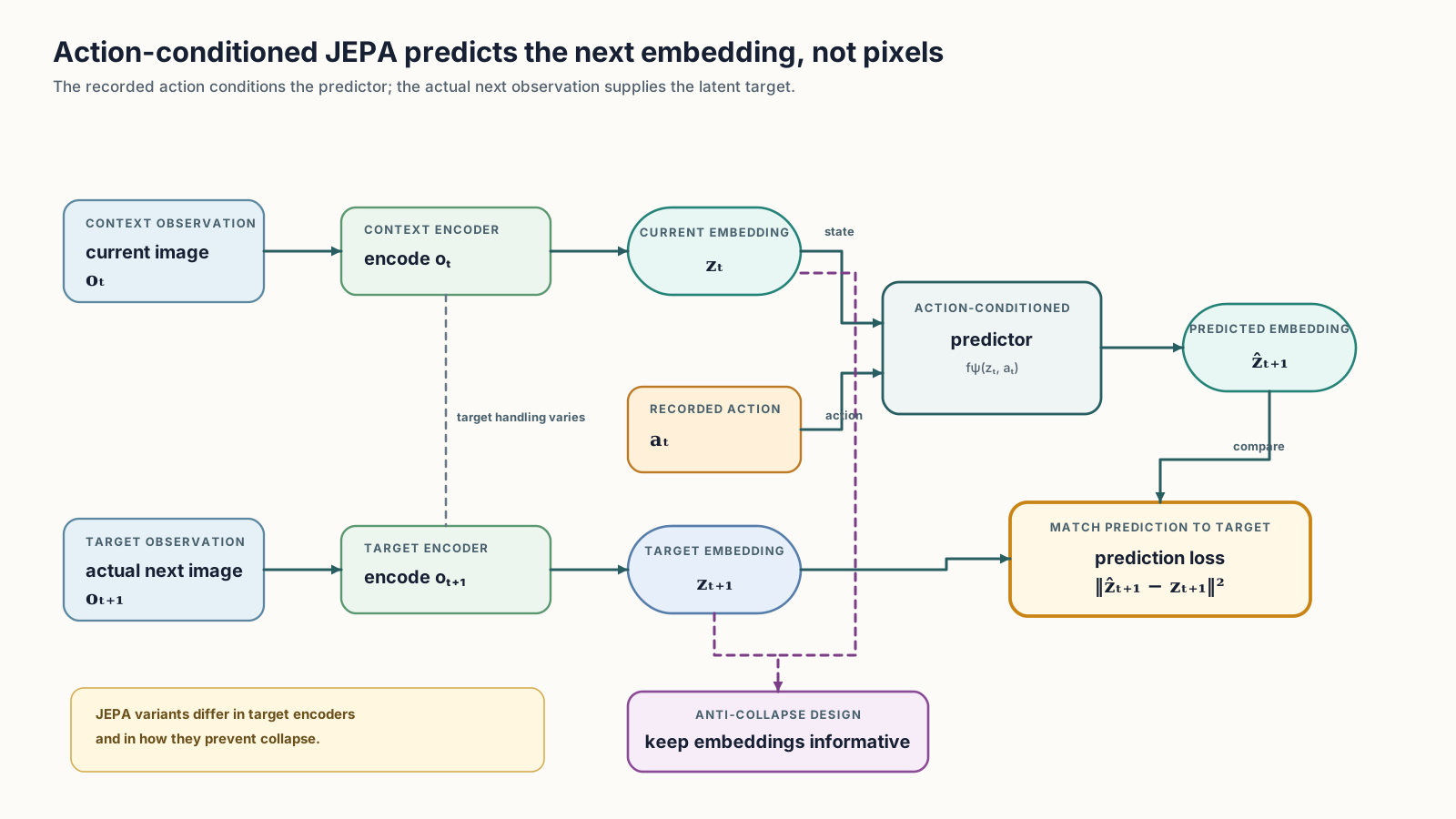
The prediction loss is commonly a squared distance:
The phrase joint embedding emphasizes that both the context and target are represented in a learned space. Different JEPA variants use different mechanisms to keep this space meaningful:
- a frozen or pretrained target encoder;
- a stop-gradient and an exponential-moving-average target encoder;
- variance/covariance regularizers;
- architectural bottlenecks and masking;
- an explicit distributional regularizer such as SIGReg.
Why collapse is the central problem
The prediction loss alone has a degenerate solution:
Then the predictor can always output (c), making the prediction loss small while the representation contains no usable information. This is representation collapse. It is not a minor implementation issue; it determines whether a JEPA learns a control-relevant state or a constant vector.
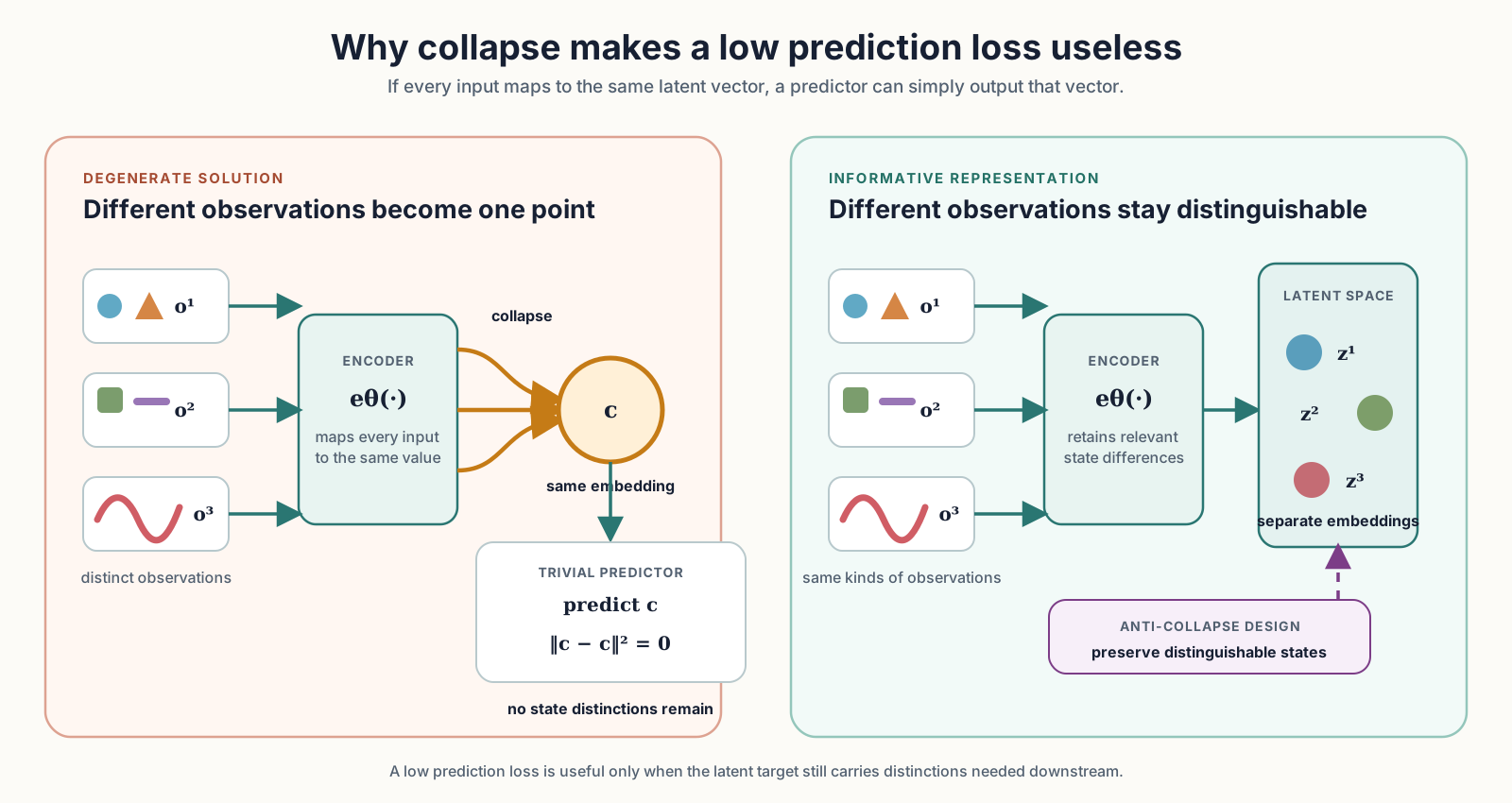
The remaining question is how this predictive template becomes a control model: which transition supplies the target, and where does the action enter?
How an action-conditioned JEPA is trained
Training starts with an offline dataset of real transitions:
For a batch of trajectory segments:
- Encode the observed frames into latent embeddings (z_t=e_\theta(o_t)).
- Give the predictor the current or recent latent history and the recorded action (a_t).
- Predict the next latent (hat z_{t+1}).
- Compare it to the embedding of the actual next observed frame (z_{t+1}=e_\theta(o_{t+1})).
- Add an anti-collapse term and update the encoder and predictor together, or update a target encoder separately depending on the method.
For action-conditioned models, (a_t) is normally a continuous command recorded by the data-collection policy. It is not inferred from the image. The encoder may receive only the image, while the predictor receives the action condition; nevertheless, the encoder learns action-relevant features because gradients from action-conditioned prediction flow back through it.
This is self-supervised with respect to labels: the next observation provides the target, without a human annotation, reward, or task label. It is not action-free learning. The action is an observed part of the trajectory and is essential if the system is expected to distinguish “turn left” from “turn right.”
This is the generic training recipe. LeWM is a particular instantiation: it jointly trains the encoder and predictor from logged trajectories, uses SIGReg to resist collapse, and exposes the resulting dynamics to a latent-space planner.
LeWorldModel: a stable end-to-end latent planner
LeWorldModel: Stable End-to-End Joint-Embedding Predictive Architecture from Pixels is a particularly clean JEPA-style design. It jointly trains an image encoder and an action-conditioned predictor directly from pixel-action trajectories. Its stated contribution is not that it solves world modeling universally; it is that a compact end-to-end latent model can be trained stably with a simple two-term objective.
Architecture
LeWM uses:
- a ViT-Tiny image encoder that maps frames to a 192-dimensional latent representation;
- a transformer predictor that receives a short latent history and action history;
- Adaptive Layer Normalization (AdaLN) to inject actions into the predictor;
- a latent-space planning loop that selects action sequences whose predicted terminal latent is close to the latent of a goal image.
The encoder receives the image. The predictor receives the action condition. This distinction is useful: the encoder answers “what state is this image describing?” while the predictor answers “how does this state evolve under this action?”
Where the actions and targets come from
LeWM trains on offline trajectories collected by behavior policies. The action condition is the control command that was actually executed between observations. The paper uses a frame skip of five, so a model-level action condition can be a block of five primitive actions.
The training target is not an annotated physical state, a reward, or a goal label. It is the latent embedding of the actual next frame in the recorded trajectory:
The complete prediction objective is therefore:
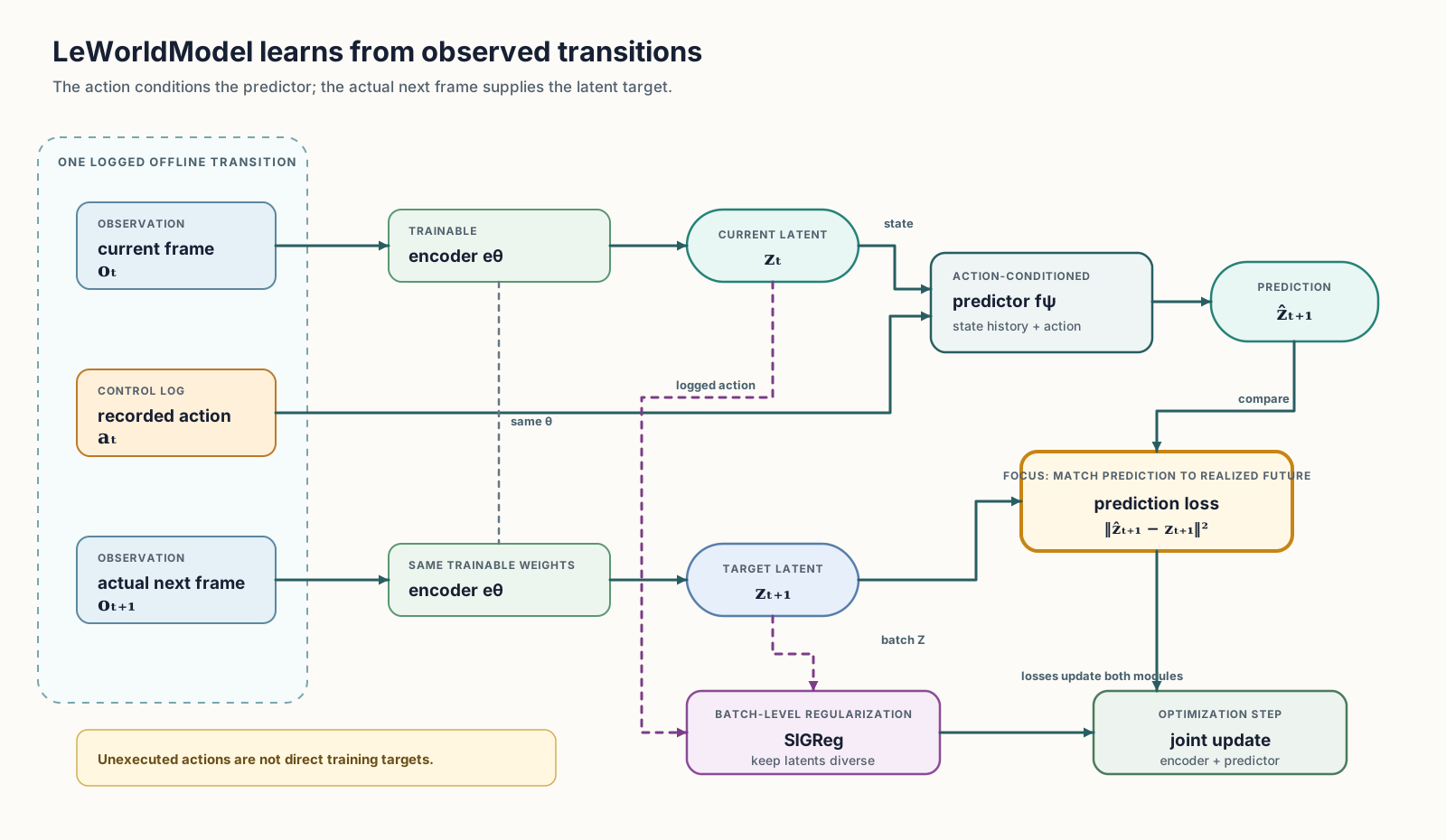
The target embedding is produced by the same trainable encoder, not a frozen DINO or EMA teacher. This makes collapse prevention especially important. The paper’s offline datasets include both expert-like and heuristic data-collection policies across TwoRoom, PushT, OGBench-Cube, and Reacher; see its implementation and dataset appendices for the exact policies and episode counts. Local reading notes provide a code-oriented walkthrough.
SIGReg: the anti-collapse term
LeWM adds the Sketched-Isotropic-Gaussian Regularizer (SIGReg):
Informally, SIGReg encourages the batch of latent embeddings (Z) to behave like samples from an isotropic Gaussian. It projects embeddings along many random one-dimensional directions and penalizes departures from a standard normal distribution in those projections. The intended effect is a latent space with diversity, scale, and non-collapse without requiring a frozen target encoder, pixel decoder, or a large collection of hand-balanced regularizers.
This is a useful inductive bias, not a proof that every latent dimension corresponds to a meaningful physical variable. A latent distribution can look healthy while still encoding shortcuts or omitting a rare but safety-critical factor.
Why LeWM can be small and fast
LeWM’s planning operates on a compact 192-dimensional latent vector, not high-dimensional visual feature maps or reconstructed images. That lowers the cost of rolling out many candidate action sequences under model-predictive control. Its small size is therefore an interface decision: it trades visual detail for a compact state intended to support action selection.
The downstream test is not parameter count alone. A compact model is only an improvement if it preserves the variables needed for goal reaching, uncertainty estimation, and recovery from model mistakes. The LeWM paper reports competitive results in several planning environments and stronger performance than its end-to-end JEPA baseline in some settings, while also showing weaker results in the low-diversity TwoRoom setting. That is exactly the right kind of result: compactness helps, but the representation prior and data distribution still matter.
Planning is a separate optimization problem
After training, LeWM fixes the world-model parameters and uses a planner such as the Cross-Entropy Method (CEM) to optimize an action sequence:
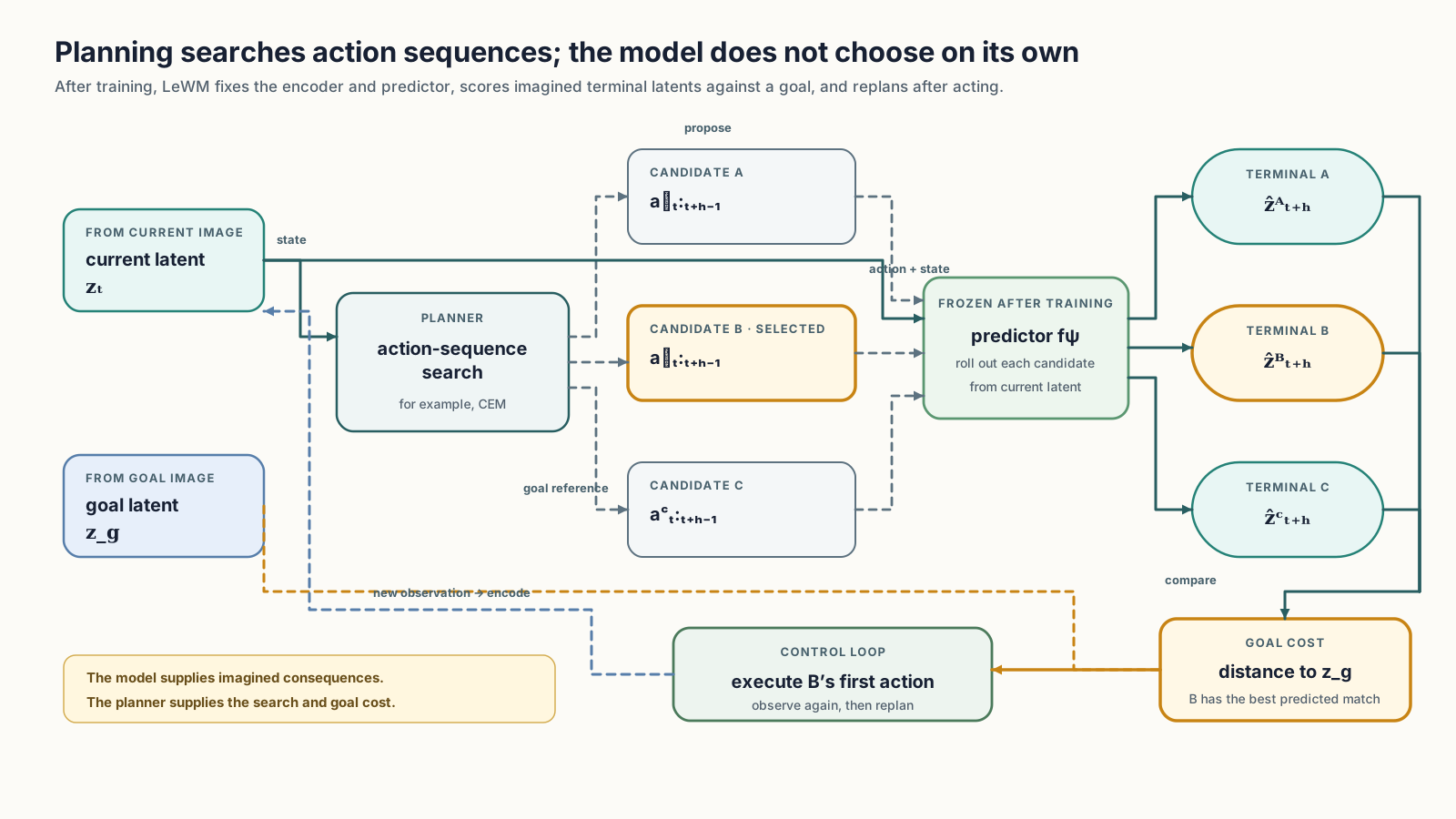
This highlights a frequent source of confusion. A good latent dynamics model does not itself choose actions. It supplies imagined consequences; a planner supplies the action search and the goal cost. Both can fail independently.
Context: three broader world-model agendas
LeWM occupies only one part of a much broader landscape. A useful contextual framing—prompted by Natasha Malpani’s discussion of world-model directions—is to distinguish three overlapping agendas by the artifact they aim to build and the failure they must avoid. The synthesis and analysis below are this article’s own.
| Agenda | Representative direction | Primary artifact | Core question | A decisive failure |
|---|---|---|---|---|
| Cognitive architecture | Yann LeCun’s objective-driven / AMI framing | A system that perceives, remembers, predicts, evaluates, and acts | Can an agent select useful actions by imagining their consequences? | It predicts well but cannot form or execute useful plans. |
| Physical-AI infrastructure | NVIDIA Omniverse, Isaac, and Cosmos | A development stack: simulation, synthetic-data generation, evaluation, and foundation models | Can developers build, test, and deploy robots or autonomous systems safely and at scale? | The simulated or generated data does not transfer to the deployed system. |
| Spatial intelligence | Fei-Fei Li and World Labs | Persistent, editable, navigable 3D world representations | Can a model recover and manipulate the geometry and semantics of a scene? | The scene looks plausible but breaks under movement, editing, measurement, or interaction. |
LeCun’s agenda is broader than a predictor: it places a configurable world model inside an objective-driven architecture with perception, memory, an actor, and objective or cost modules. The hard problem is not only forecasting but deciding which futures are worth evaluating and how to connect them to long-horizon objectives. LeCun’s AMI proposal and Meta’s overview describe this larger system view.
NVIDIA’s framing is closer to an industrial development stack. Simulation and synthetic-data systems are valuable not only for data volume, but for reproducible failures, safe access to rare conditions, privileged labels, controlled variation, and regression testing. Their persistent challenge is sim-to-real calibration: contact, deformable materials, perception noise, human behavior, and long-tail deployment conditions remain difficult to model. NVIDIA’s Cosmos overview positions Omniverse as simulation infrastructure and Cosmos as a model and data layer for physical AI.
World Labs emphasizes spatially cohesive, persistent worlds that can be generated, navigated, and edited. That agenda tests whether geometry, depth, layout, and viewpoint consistency survive use—but spatial consistency alone does not guarantee trustworthy contact dynamics, hidden-state reasoning, or task consequences. World Labs’ overview and its functional taxonomy of renderers, simulators, and planners make this distinction explicit.
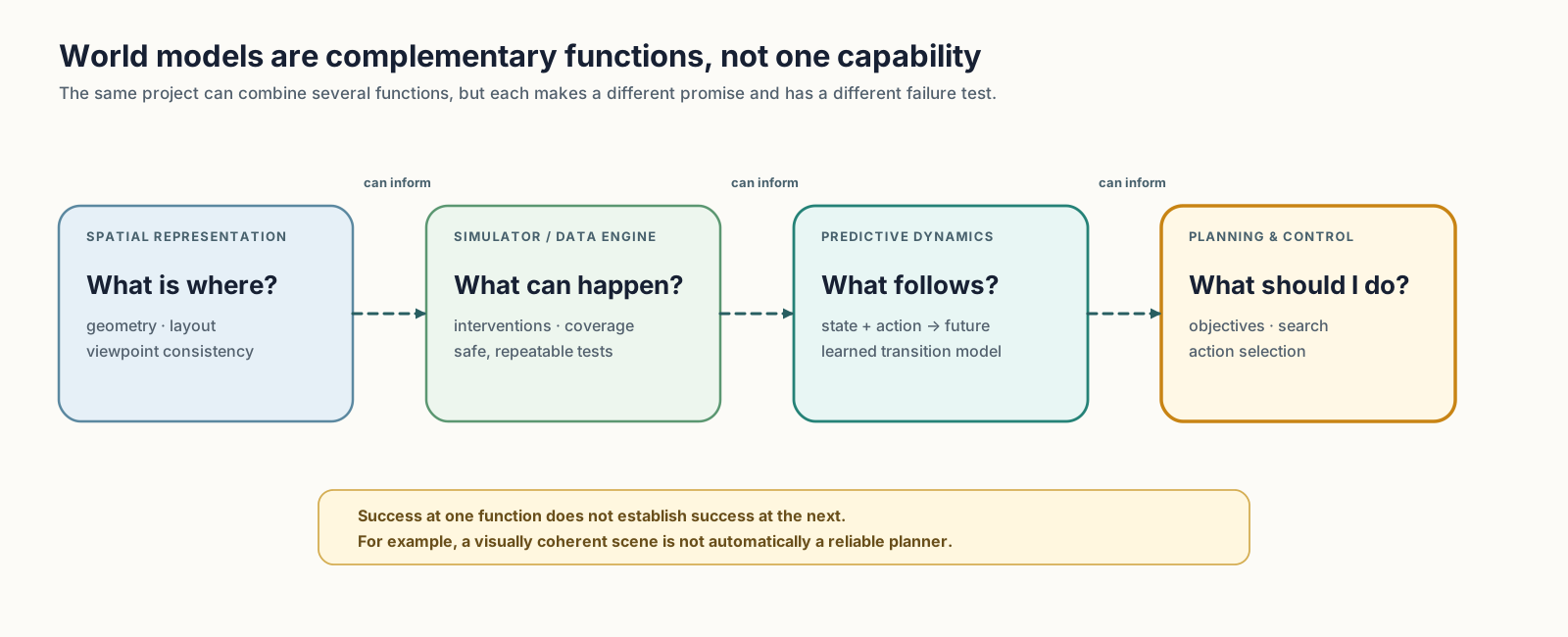
The mistake is to treat success at one function as success at every function. LeWM belongs most directly to predictive dynamics and a lightweight planning interface; it is not, by itself, a complete cognitive architecture, a simulator, or a persistent 3D scene model.
Three design debates: pretrained features, reconstruction, and rewards
Are pretrained CLIP or DINO features bad?
No. A pretrained encoder can be a strong engineering starting point. CLIP showed that image–text pretraining can yield transferable visual representations, while DINOv2 demonstrated all-purpose visual features from large-scale self-supervised vision pretraining.
For a limited robotics dataset, such features can provide useful visual invariances and stable targets for learning. They may reduce the data burden and make collapse easier to avoid, although their pretraining objective does not guarantee that they retain the state variables a particular control task needs.
The limitation is not “pretraining is bad.” It is that a frozen representation optimizes for the pretraining objective and distribution, not necessarily for the action-conditioned control problem.
| Potential benefit of a pretrained encoder | Potential limitation for world modeling |
|---|---|
| Broad visual semantics and robustness | May discard subtle state variables needed for contact, force, velocity, or control. |
| Stable targets for predictor training | Cannot adapt its representation to the environment’s specific action dynamics. |
| Often strong with limited robot data | May be expensive if planning repeatedly uses many patch tokens or high-dimensional features. |
| CLIP can align images with language concepts | Natural-language concepts are not automatically calibrated continuous control actions or causal effects. |
For example, CLIP may recognize “a hand opening a fridge,” but a robot controller needs a grounded mapping from motor commands, hinge state, contact force, and starting geometry to future observations. Those are different competencies. Language can be an excellent goal or task interface, but it does not replace action-conditioned dynamics.
The best practical answer may be hybrid: initialize from a pretrained representation, then adapt only the layers or subspace that must become action-sensitive; or combine a frozen semantic branch with a trainable control branch. The LeWM results themselves leave room for this view: frozen foundation features can retain advantages on visually rich or rotation-sensitive tasks, while a compact end-to-end representation can be cheaper and more directly tailored to planning.
Why be reconstruction-free instead of Dreamer-style?
Dreamer-style agents learn a stochastic latent state-space model and use imagined trajectories to train an actor and critic. DreamerV3’s world model includes a reconstruction objective over observations in addition to reward and continuation prediction. That is a powerful recipe for reinforcement learning from images. DreamerV3 is evidence that reconstruction-based world models can scale across diverse domains.
The case for reconstruction-free JEPA training is narrower:
- reconstruction rewards retaining every predictable pixel detail, even when it does not affect the downstream decision;
- a compact predictive embedding may let a planner evaluate many more futures;
- the model can focus its capacity on action-conditioned state evolution rather than rendering;
- it avoids coupling success to a high-quality image decoder.
But reconstruction-free is not a free win. It may hide errors that are obvious in pixel space, discard an apparently minor cue that matters at a rare decision point, and make rollout debugging less intuitive. A decoder trained after world-model training can help inspect latents, but it does not repair information that was never retained.
The sensible comparison is not “JEPA versus Dreamer.” It is:
Does the representation preserve the information required by the intended planner or policy, at the compute budget and uncertainty level of the application?
For a robot that must reason about fine visual contacts, a reconstruction or segmentation auxiliary loss may help. For a task with cluttered but irrelevant backgrounds and a tight planning budget, reconstruction-free learning may be preferable. These are empirical design choices.
Why be reward-free instead of TD-MPC?
LeWM learns dynamics without reward labels, then later uses a goal image and a latent-distance cost. The appeal is reuse: the same model could potentially support many downstream goals, provided the offline data covers the relevant dynamics.
TD-MPC takes a different and equally legitimate route. It learns a task-oriented latent model together with reward and value estimates, then plans using predicted reward and a terminal value function. TD-MPC explicitly frames its latent model around variables predictive of return.
| Reward-free latent dynamics (LeWM-style) | Reward/value-aware latent dynamics (TD-MPC-style) |
|---|---|
| Learns from observation-action trajectories without task reward | Learns from rewards and temporal-difference targets as well as transitions |
| Can be reused across later objectives | Directly optimizes a specified task and can ignore irrelevant dynamics |
| Needs a later goal representation or cost function | Has an explicit reward and value interface for planning |
| Risks keeping information that is not useful, or missing what a later task needs | Risks becoming blind to state variables that do not affect the training reward but matter for transfer or safety |
Reward-free does not mean “more intelligent” by default. It means the training signal is less tied to one task. It buys flexibility only when the data, representation, and planning cost provide enough coverage to support future goals.
A practical selection rule
Start with the deployment constraint, not the label “world model”:
| If the main need is… | A sensible starting point | Do not assume… |
|---|---|---|
| Human-inspectable forecasts or several plausible visual futures | A stochastic pixel or video model | Visual realism alone makes the model controllable. |
| Fast goal-image planning with well-covered action data | Compact action-conditioned latent dynamics | Latent distance is automatically a sufficient goal or safety metric. |
| A defined task reward and online task learning | A reward/value-aware latent model | The task-specific representation will transfer unchanged to new objectives. |
| Safety-critical operation, partial observability, or tail events | Better intervention data and uncertainty-aware planning before a larger planner | More optimization will repair unsupported or miscalibrated dynamics. |
The question is not which column is universally best. It is which failure mode the system must avoid first—and whether its data and evaluation can support that choice.
The real limitations: counterfactual coverage, uncertainty, memory, and planning
The most valuable critique of LeWM is not that it has no action data. It does: the action is the recorded command in each offline transition. The real issue is that the dataset contains only the outcomes of actions that were actually tried.
1. Logged transitions are not counterfactual knowledge
For a recorded transition,
the model observes what happened after (a_t). It does not directly observe what would have happened from the same underlying state had the system instead taken (a'_t) or (a''_t). If the behavior policy rarely turns right near a hazard, the data give little direct evidence about that action’s outcome there.
Calling the data “positive-only” is directionally useful but imprecise. The problem is not the lack of a binary negative label. It is support: the model is supervised only on state-action regions visited by the data-collection policy. A mismatched action-next-state pair can be used as a contrastive negative, but it does not reveal the true counterfactual next state.
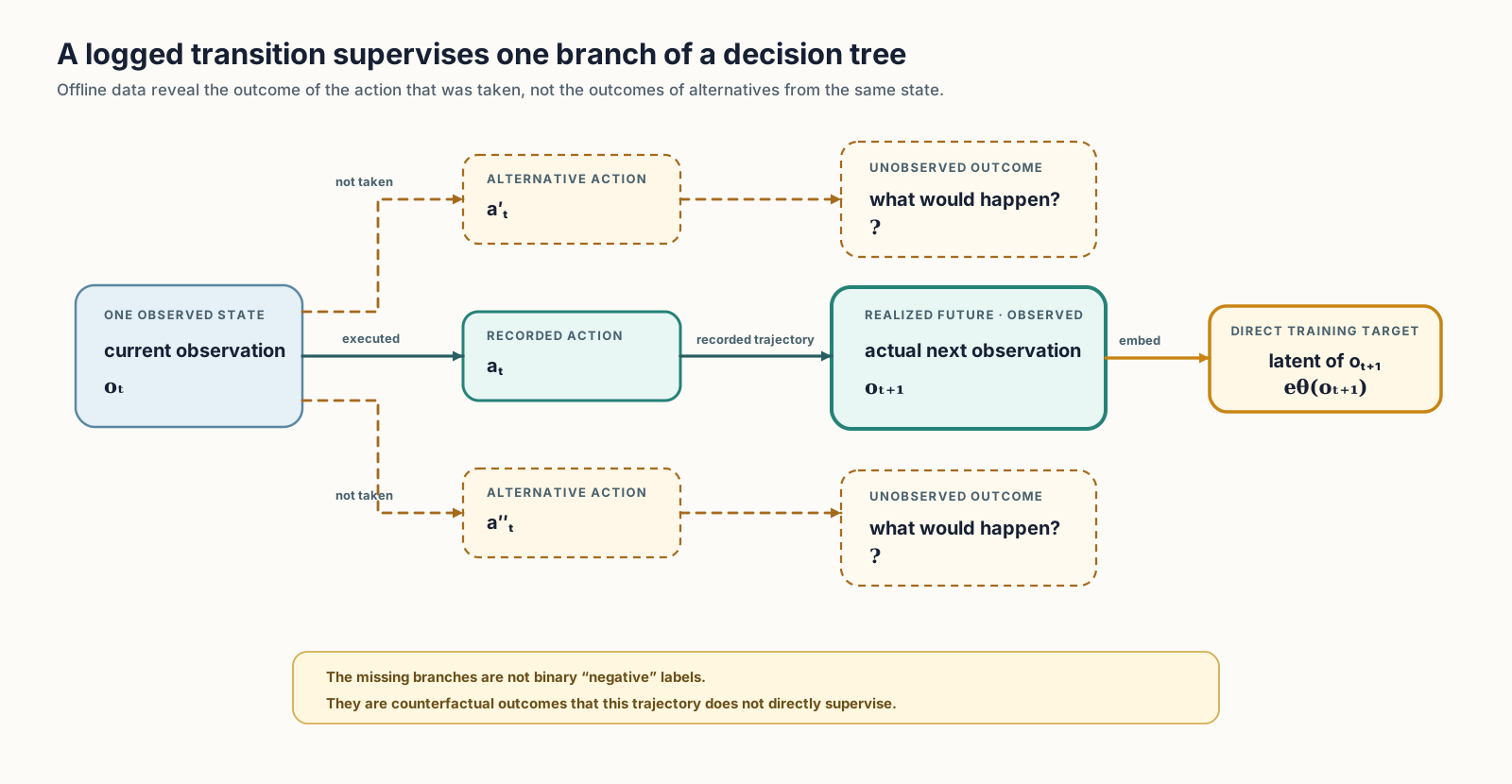
This creates several risks:
- the planner proposes an out-of-distribution action sequence because the learned model is overly optimistic there;
- rare collisions, slips, occlusions, and equipment faults are underrepresented;
- normal trajectories dominate the loss, so the model may smooth away tail events;
- an action-sensitive predictor can still learn a shortcut if a particular action is correlated with a background or goal position in the dataset.
What would help? Broader action coverage, targeted interventions, randomized or exploratory collection, high-fidelity simulation, uncertainty-aware planners, and evaluation on deliberately counterfactual transitions. Negative-pair or adversarial training can improve action sensitivity, but it must be paired with valid physical targets or uncertainty estimates; otherwise it may simply teach the model to reject mismatched pairs without learning the alternative outcome.
2. One observed future may conceal many plausible futures
The LeWM prediction loss is a point estimate in latent space. In partially observed or stochastic environments, the same image and action can yield multiple plausible futures: an object may be slippery, another agent may move, or an occluded object may have one of several positions. A deterministic MSE predictor tends to average alternatives, which may produce an implausible “mean future.”
Potential remedies include probabilistic latent dynamics, ensembles, diffusion or latent-variable predictors, and planning that penalizes epistemic uncertainty rather than only latent goal distance. The key is to make uncertainty operational: it should influence whether the planner executes, gathers more information, chooses a robust action, or hands control to a safer policy.
3. Finite context is not persistent memory
LeWM is not memoryless: its predictor receives a short history of latent frames and actions. But this is not the same as a recurrent belief state or persistent memory that survives beyond a fixed context window. It can struggle when the next action depends on information that was visible long ago, is now occluded, or must be integrated across episodes.
This distinction matters for physical tasks involving object permanence, delayed effects, hidden state, or long-horizon strategy. Promising extensions include recurrent state-space models, state-space sequence models, transformer memory, external retrieval, and explicit belief-state objectives. They should be evaluated with history-aliasing tests: two trajectories with identical recent frames but different earlier events should require different predictions or actions.
4. Anti-collapse is not causal or safety grounding
SIGReg can keep embeddings diverse and well conditioned. It does not prove that the model represents causal variables, that its latent distance is meaningful for every task, or that it understands safety constraints. A latent can encode a visually predictive shortcut that works on the training distribution and still fail under an intervention.
Useful tests go beyond average prediction loss:
- action-swap tests: hold the state fixed and change the action;
- intervention tests: change one physical variable while preserving appearance where possible;
- dynamic-consistency tests: compare imagined action outcomes with realized outcomes;
- out-of-distribution detection and uncertainty calibration;
- locality tests after a model edit or unlearning operation.
5. A latent-distance goal is an assumption, not a universal objective
LeWM plans by minimizing the distance between a predicted terminal latent and the latent of a goal image. This is elegant, but it assumes Euclidean proximity in the learned representation tracks goal achievement. It may fail when:
- visually similar states require different actions or have different hidden causes;
- there are several valid ways to achieve the goal;
- the goal image hides an important temporal condition, such as whether a door is opening or closing;
- safety constraints matter even when the terminal image looks right.
A future system could use learned goal metrics, constraint models, temporal goal descriptions, language-conditioned objectives, or a combination of latent distance and reachability/uncertainty penalties.
6. Long-horizon rollouts amplify model error
LeWM rolls out a one-step predictor autoregressively. Small errors enter the next model input and can compound. The later Fast LeWorldModel explores action-prefix prediction as one response: predict several future horizons directly from an observed anchor latent and action prefixes, rather than repeatedly feeding predicted latents back into a one-step transition model.
This is a reminder that architecture and planning interface matter. Even an accurate local model can be a poor long-horizon simulator when used recursively.
7. A planner can exploit its own model
MPC searches for action sequences that look good according to the learned model. This creates a familiar failure mode: optimization finds an action sequence in a region where the model is wrong but confidently predicts a low cost. More optimization can make this worse.
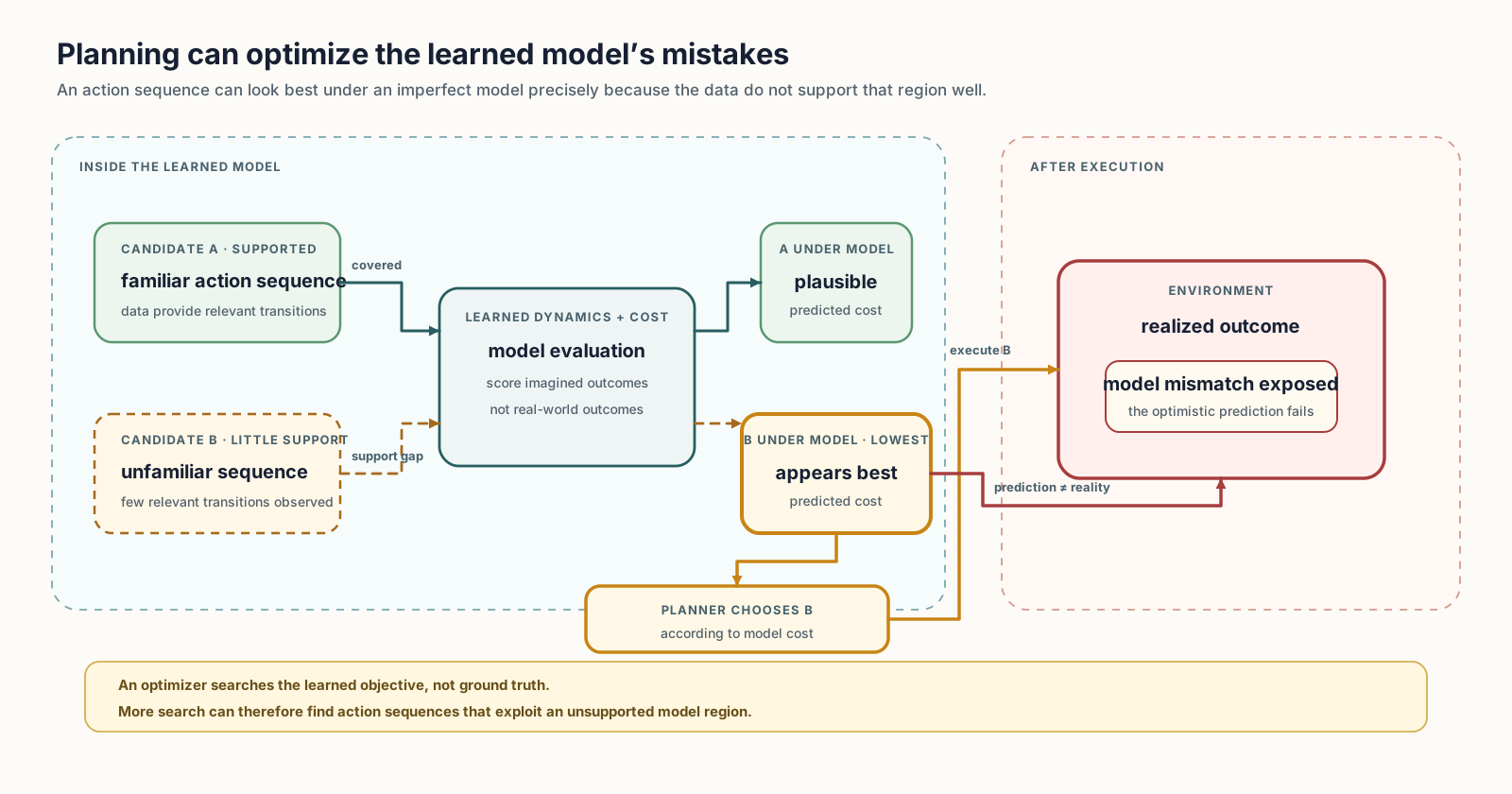
Robust planning needs model uncertainty, conservative objectives, real-world replanning, safety filters, and explicit evaluation against model exploitation. A world model should be assessed not only by whether it predicts held-out data, but by whether an optimizer can reliably exploit its errors.
Research directions: from predictive models to reliable models
The limitations above suggest a practical research program. Each idea below is a hypothesis, not a claim that it will work without careful evaluation.
| Direction | Core idea | Minimal empirical test |
|---|---|---|
| Coverage-aware data collection | Collect transitions where actions are deliberately diversified near important states | Compare a policy-trained dataset with an intervention-rich dataset at matched size; measure counterfactual action accuracy. |
| Action-sensitivity objectives | Require the latent effect of an action to be distinguishable from alternative actions when the environment supports that distinction | Use action swaps or mismatched action-next-state negatives; verify that the model does not merely learn superficial action IDs. |
| Uncertainty-aware world models | Predict a distribution or ensemble over future latents and plan conservatively | Measure calibration under held-out shifts and whether uncertainty prevents unsafe model exploitation. |
| Memory and belief state | Preserve relevant hidden history beyond a short window | Build history-aliasing tasks with the same recent frames but different hidden causes. |
| Multi-horizon dynamics | Predict action-prefix outcomes or variable-horizon futures directly | Compare one-step rollout error growth with direct prefix prediction at equal compute. |
| Causal intervention benchmarks | Evaluate whether changing a physical variable has the correct predicted consequence | Train on normal trajectories; test teleports, friction shifts, occlusions, and object substitutions. |
| Editable and forgettable dynamics | Localize a change to a state-action region while preserving unrelated predictions | Edit one transition rule, then report edit success, locality, rollout divergence, and downstream policy change. |
| Hybrid semantic-control representations | Combine pretrained semantic features with a trainable action-sensitive state | Test whether the hybrid improves transfer without degrading contact or fine-motion prediction. |
For world-model unlearning, the most interesting target is often not a fact but a transition belief: “from states like this, this action causes that outcome.” An edit should remove or correct that belief locally while preserving unrelated dynamics and calibrated uncertainty. That is a much stronger requirement than making a model produce a different latent vector on a single probe.
Takeaways
- “World model” names a family of functions, not one capability. Distinguish rendering, simulation, spatial representation, predictive dynamics, and planning.
- Latent prediction is valuable when the latent state is sufficient for the downstream decision. It is not automatically more meaningful than pixel prediction.
- JEPA replaces target reconstruction with target-embedding prediction. The resulting collapse problem is fundamental, not cosmetic.
- LeWorldModel is action-conditioned and self-supervised. Its actions are logged controls from offline trajectories; its target is the embedding of the actual next observed frame; it uses no reward or privileged-state labels for world-model training.
- Pretrained features, reconstruction, and reward signals are design choices—not moral categories. Each changes the trade-off between stability, control specificity, transfer, compute, and observability.
- The sharpest limitation is counterfactual coverage. Logged data teaches what happened for actions that were taken, not automatically what would have happened for alternatives.
- A predictor becomes a reliable world model only when it is evaluated under intervention, uncertainty, partial observability, long horizons, and an optimizer trying to exploit it.
References and further reading
- Yann LeCun, A Path Towards Autonomous Machine Intelligence, 2022.
- Mahmoud Assran et al., Self-Supervised Learning from Images with a Joint-Embedding Predictive Architecture, 2023.
- Adrien Bardes et al., Revisiting Feature Prediction for Learning Visual Representations from Video, 2024.
- Alec Radford et al., Learning Transferable Visual Models From Natural Language Supervision, 2021.
- Maxime Oquab et al., DINOv2: Learning Robust Visual Features without Supervision, 2023.
- Lucas Maes et al., LeWorldModel: Stable End-to-End Joint-Embedding Predictive Architecture from Pixels, 2026. See also the local paper reading notes.
- NVIDIA, Cosmos: Physical AI with World Foundation Models.
- World Labs, A Functional Taxonomy of World Models, 2026.
- Natasha Malpani, X post discussing world-model directions, 2026.
- Danijar Hafner et al., Mastering Diverse Domains through World Models, 2023.
- Nicklas Hansen, Xiaolong Wang, and Hao Su, Temporal Difference Learning for Model Predictive Control, 2022.
- Yuntian Gao and Xiangyu Xu, Fast LeWorldModel, 2026.
Enjoy Reading This Article?
Here are some more articles you might like to read next: