AI Agents 101 | 08. Data Layer and Enterprise Integration
Data Layer and Enterprise Integration
Enterprise agents are only as useful as the systems they can safely understand.
The model may be impressive, but the real work lives in documents, databases, tickets, contracts, logs, dashboards, emails, calendars, code repositories, customer records, policies, and internal tools. Agent engineering therefore becomes data engineering very quickly.
The data layer decides what the agent can know, what it can prove, and what it is allowed to touch.
Level 1: Fundamentals
Retrieval-augmented generation is the baseline pattern for connecting a model to private or changing knowledge. The original RAG paper describes combining a model's parametric knowledge with a non-parametric dense vector index, improving knowledge-intensive tasks and factual specificity [1].
OpenAI's retrieval docs describe semantic search over vector stores as a way to surface relevant information for model synthesis [2], while file search gives models access to uploaded file-backed vector stores through semantic and keyword search [3].
That solves one part of the problem: finding relevant information.
Enterprise integration adds harder questions:
- who is allowed to see this document?
- is this source current?
- is this data authoritative?
- can the answer cite evidence?
- did the agent read from production or a sandbox?
- can the agent write back to a system of record?
- what happens if retrieved content contains malicious instructions?
OpenAI's accuracy guidance explicitly names context optimization as the lever for proprietary, outdated, or missing knowledge [4]. In enterprise work, that is most of the problem.
The Hitchhiker guide expands the retrieval layer into a system of chunking, query transformation, reranking, compression, Graph RAG, adaptive RAG, and agentic RAG patterns [6].
Level 2: Concepts
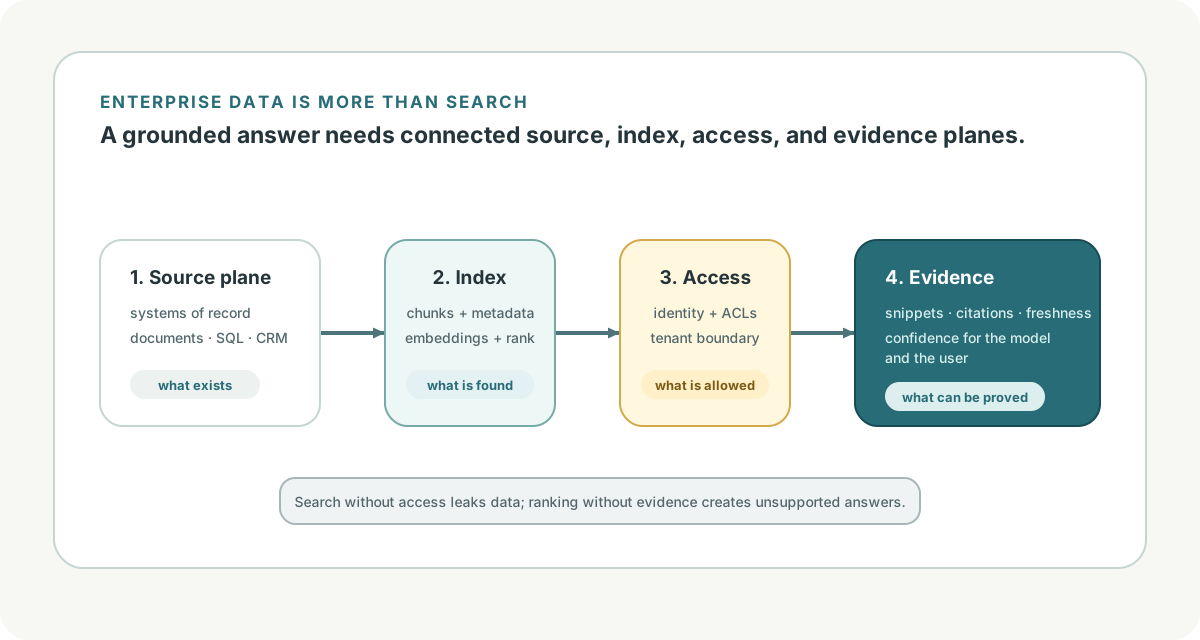
Think of the enterprise data layer as four planes:
| Plane | Job | Examples |
|---|---|---|
| Source plane | connect to systems of record | SharePoint, Drive, Slack, Jira, Salesforce, Git, SQL |
| Index plane | prepare searchable representations | chunks, metadata, embeddings, keywords, graphs |
| Access plane | enforce permissions and tenancy | ACLs, identity mapping, row-level security |
| Evidence plane | package grounded context for the model | snippets, citations, freshness, confidence |
Agents need all four. Search without permission is a data leak. Permission without ranking is frustrating. Ranking without evidence creates unsupported answers. Evidence without freshness creates stale confidence.
Ingestion
Ingestion is not just loading documents.
source connector
  -> identity and ACL mapping
  -> document parsing
  -> chunking
  -> metadata extraction
  -> embedding and keyword indexing
  -> freshness tracking
  -> deletion/update sync
The deletion path matters as much as the ingestion path. If a user loses access to a document, or the document is deleted, the index must reflect that.
Retrieval
Retrieval should usually be staged:
intent -> query rewrite -> candidate search -> permission filter -> rerank -> compress -> cite
Some systems filter permissions before search, some after candidate retrieval, and some at both points. The safe rule is that restricted content must never reach the model if the requesting user cannot access it.
Authority
Not every source should have the same weight.
| Source | Typical Authority |
|---|---|
| current official policy doc | high |
| system-of-record API | high |
| stale exported PDF | medium to low |
| chat message | low unless linked to decision |
| model memory | low unless verified |
| retrieved web page | depends on source |
The agent should know when a source is authoritative and when it is background context.
Write-Back
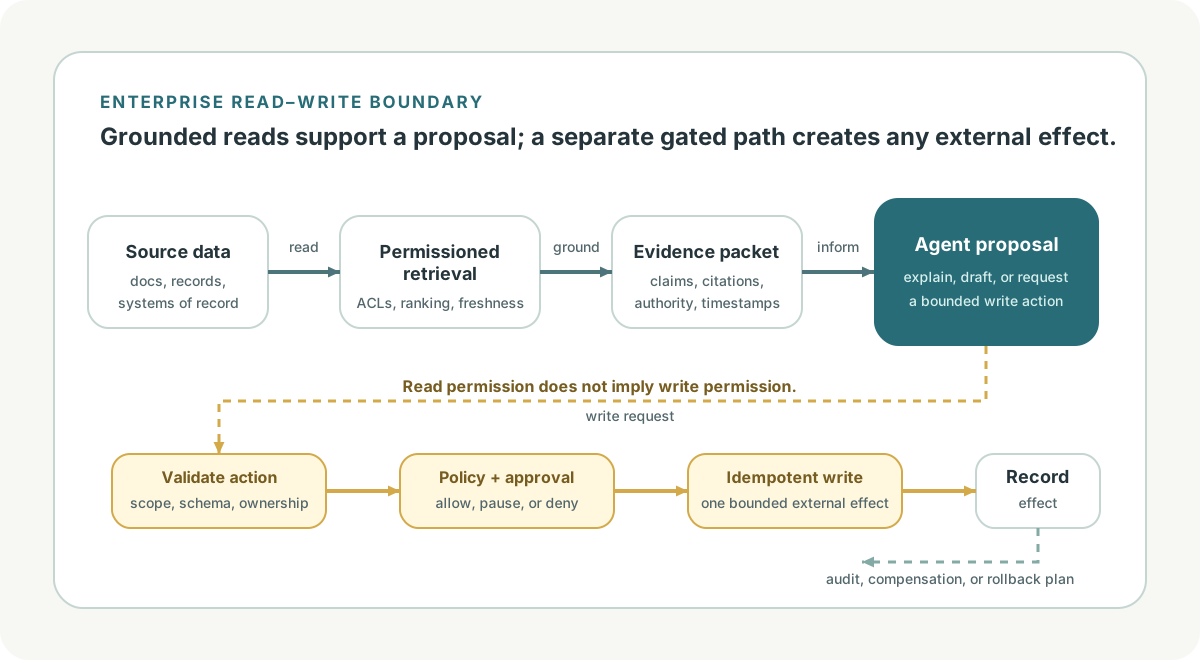
Enterprise agents often need to act: update a CRM record, create a ticket, draft an email, stage a refund, or open a pull request.
Write-back should be designed separately from read access. A tool that can read a customer profile should not automatically be able to change it.
Action tools should include:
- permission checks
- validation
- idempotency keys
- dry-run mode
- approval gates
- audit logs
- rollback or compensation strategy
Level 3: Engineering Detail
A practical enterprise data layer starts with metadata.
Document Chunk
{
  "chunk_id": "policy_refunds_2026_04#p12",
  "source_id": "policy_refunds_2026_04",
  "source_type": "policy_doc",
  "title": "Refund Policy",
  "text": "Customers may request a refund within 30 days...",
  "url": "https://intranet.example/policies/refunds",
  "created_at": "2026-04-01T00:00:00Z",
  "updated_at": "2026-06-15T00:00:00Z",
  "owner": "support-policy",
  "acl": ["support_team", "billing_team"],
  "authority": "official_policy",
  "sensitivity": "internal",
  "embedding_model": "text-embedding-...",
  "checksum": "sha256:..."
}
If metadata is poor, retrieval quality becomes guesswork. If ACLs are missing, retrieval becomes dangerous.
Query Plan
{
  "user_id": "usr_123",
  "intent": "refund eligibility",
  "sources": ["policy_docs", "orders_db", "case_notes"],
  "filters": {
    "customer_id": "cust_456",
    "authority": ["official_policy", "system_of_record"],
    "max_age_days": 90
  },
  "must_cite": true,
  "allow_web": false
}
The model can help plan retrieval, but the runtime should enforce the plan's security constraints.
Grounded Answer Packet
The retrieval layer should return an evidence packet, not a blob:
{
  "claim": "The order is eligible for refund review.",
  "evidence": [
    {
      "source": "Refund Policy",
      "url": "https://intranet.example/policies/refunds#section-3",
      "excerpt": "Refunds may be reviewed within 30 days...",
      "updated_at": "2026-06-15",
      "authority": "official_policy"
    },
    {
      "source": "Orders API",
      "record_id": "ord_789",
      "observed_at": "2026-07-06T11:00:00Z",
      "authority": "system_of_record"
    }
  ]
}
This makes citation, audit, and evaluation easier.
Integration Failure Modes
| Failure | Cause | Prevention |
|---|---|---|
| stale answer | old indexed copy outranks live source | freshness metadata and revalidation |
| data leak | retrieval ignores ACLs | permission-aware search |
| hallucinated citation | model cites source not in packet | structured evidence binding |
| wrong tenant | connector maps identity incorrectly | tenant-aware auth tests |
| duplicate action | retry repeats write | idempotency keys |
| unsafe write | read tool reused for mutation | separate read and write tools |
| index drift | source deleted but vector remains | deletion sync and checksums |
Current Landscape
Enterprise agent data systems are becoming hybrids.
Vector search remains important, but serious systems combine semantic search with keyword search, metadata filters, source ranking, structured APIs, and graph-like relationships. OpenAI's file search and retrieval APIs show the hosted side of this pattern [2][3]. MCP gives agents a standardized way to connect to external data and tools, but it does not remove the need for source-specific permissions and governance [5].
The practical center of gravity is shifting from "can the model answer from my docs?" to "can the system prove which authorized evidence supported the answer, and can it safely write back when needed?"
The Hitchhiker guide is useful as a pattern catalog for advanced retrieval, but original papers, official docs, and current product documentation should still be preferred for time-sensitive claims and implementation details [6].
Practical Takeaways
Build the data layer before expecting production reliability. Agent quality depends on source quality, permissions, metadata, and freshness.
Keep retrieval permission-aware. The model should never see data the user cannot access.
Store authority and freshness with every chunk. The newest chat message should not outrank an official policy by accident.
Return evidence packets, not just text snippets. Claims, citations, source metadata, and observed tool results should travel together.
Separate read tools from write tools. Enterprise side effects need validation, idempotency, approval, and audit trails.
Evaluate retrieval separately from generation. If the right evidence is never retrieved, the model cannot reliably synthesize the right answer.
References
[1] "Retrieval-Augmented Generation for Knowledge-Intensive NLP Tasks." Patrick Lewis et al. https://arxiv.org/abs/2005.11401. Published/updated: 2021-04-12. Accessed: 2026-07-06. Used for: RAG architecture, parametric and non-parametric knowledge, and retrieval for factual specificity.
[2] "Retrieval." OpenAI API documentation. https://developers.openai.com/api/docs/guides/retrieval. Published/updated: not listed. Accessed: 2026-07-06. Used for: semantic search, vector stores, and retrieval for model synthesis.
[3] "File search." OpenAI API documentation. https://developers.openai.com/api/docs/guides/tools-file-search. Published/updated: not listed. Accessed: 2026-07-06. Used for: model access to uploaded file vector stores, semantic search, keyword search, and hosted retrieval tools.
[4] "Optimizing LLM accuracy." OpenAI API documentation. https://developers.openai.com/api/docs/guides/optimizing-llm-accuracy. Published/updated: not listed. Accessed: 2026-07-06. Used for: context optimization, proprietary knowledge, outdated knowledge, and system-improvement levers.
[5] "Model Context Protocol specification, 2025-06-18." Model Context Protocol. https://modelcontextprotocol.io/specification/2025-06-18. Published/updated: 2025-06-18. Accessed: 2026-07-06. Used for: standardized integration with external data and tools.
[6] "The Hitchhiker's Guide to Agentic AI: From Foundations to Systems." Haggai Roitman. Local source: agent-101/The Hitchhiker’s Guide to Agentic AI/book.tex. Published/updated: 2026. Accessed: 2026-07-06. Used for: RAG variants, chunking, query transformation, reranking, compression, Graph RAG, adaptive RAG, and agentic RAG.
Enjoy Reading This Article?
Here are some more articles you might like to read next: