AI Agents 101 | 10. Evaluation and Observability
Evaluation and Observability
You cannot improve an agent you cannot see.
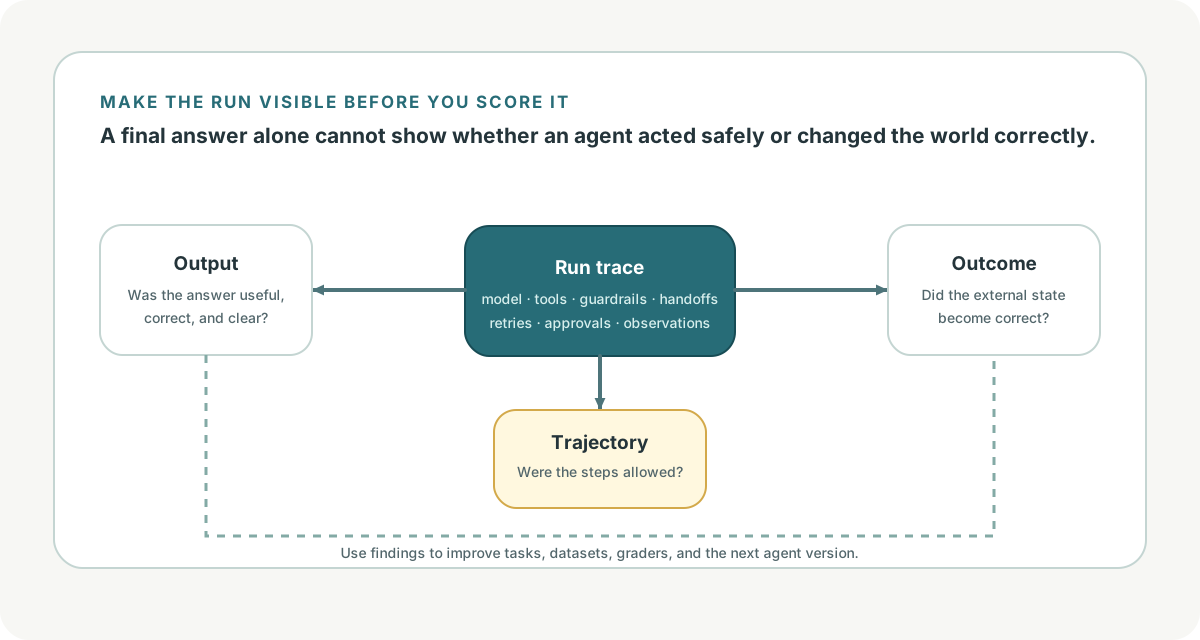
Agents are harder to evaluate than single-turn chat because they act over time. They call tools, change state, branch, recover, fail partially, ask for approval, and sometimes reach the right answer for the wrong reason. A final response alone is not enough evidence.
Evaluation asks whether the agent did the right thing. Observability shows what happened.
Level 1: Fundamentals
OpenAI's agent-evals docs describe the core pieces: traces capture model, tool, guardrail, and handoff activity; graders score outputs or traces; datasets and eval runs make measurement repeatable [1].
Anthropic's agent-evals guidance makes the same point from another angle: agent evaluations involve tasks, trials, graders, transcripts or traces, outcomes, evaluation harnesses, and suites [3]. It also emphasizes that agent mistakes can propagate because agents use tools across many turns and modify state [3].
Observability is the runtime side. OpenAI's integration docs describe tracing as an end-to-end record of runs before deeper evaluation [2]. OpenTelemetry defines observability tooling around telemetry data such as traces, metrics, and logs, with vendor-neutral APIs and conventions [5].
The Hitchhiker guide treats evaluation environments and observability as part of the agent system, not a late testing activity [7].
Level 2: Concepts
Agent evaluation has three main targets:
| Target | Question | Example |
|---|---|---|
| Output | Did the final answer satisfy the user? | correct answer, clear citations, safe wording |
| Trajectory | Did the agent take acceptable steps? | used allowed tools, did not loop, asked approval |
| Outcome | Did the external state become correct? | tests pass, ticket updated, booking exists |
Single-turn evals usually focus on output. Agent evals need all three.
Traces
A trace is the story of a run in machine-readable form:
- user input
- model calls
- tool calls
- tool observations
- guardrail decisions
- handoffs
- approvals
- retries
- errors
- final output
- timing and token usage
Without traces, debugging becomes anecdotal. With traces, failures can be grouped: bad retrieval, wrong tool choice, missing permission, schema failure, hallucinated citation, overlong loop, or weak final synthesis.
Graders
Anthropic divides graders into code-based, model-based, and human categories [3]. Each has a role.
| Grader Type | Strength | Weakness |
|---|---|---|
| Code-based | fast, objective, reproducible | limited nuance |
| Model-based | flexible, scalable for qualitative checks | non-deterministic, needs calibration |
| Human | expert judgment | slow and expensive |
The best suites often combine them. A coding-agent task might run tests, run static analysis, check tool trajectory, and use a rubric for maintainability.
Capability vs Regression
Capability evals ask: can the agent solve hard tasks it currently struggles with?
Regression evals ask: did we break behavior that used to work?
Both matter. Capability suites help climb the hill. Regression suites protect the base camp.
Red Teaming
OpenAI's red-teaming guidance frames adversarial testing as a complement to evals, especially for misuse, failure modes, and high-risk interactions [4]. For agents, red teaming should include:
- prompt injection through retrieved documents
- malicious tool outputs
- unsafe plugin behavior
- privacy boundary tests
- approval bypass attempts
- loop/cost abuse
- misleading citations
Level 3: Engineering Detail
Start by defining the event schema.
Trace Event
{
  "trace_id": "tr_123",
  "run_id": "run_456",
  "span_id": "span_789",
  "event_type": "tool_call",
  "timestamp": "2026-07-06T10:00:00Z",
  "agent": "support_agent",
  "model": "gpt-5.4",
  "tool": "lookup_order",
  "arguments": {"order_id": "ord_123"},
  "permission_decision": "allowed",
  "duration_ms": 842,
  "status": "success",
  "tokens": {"input": 1800, "output": 250}
}
Every event does not need every field, but every run should be reconstructable.
Eval Task
task:
  id: "refund_policy_edge_case_017"
  input: "Can I get a refund for a subscription renewed 33 days ago?"
  environment:
    customer_id: "cust_123"
    policy_version: "refund_policy_2026_04"
  expected:
    outcome: "escalation_created"
    must_cite:
      - "refund_policy_2026_04#late-renewals"
    must_not:
      - "promise_refund"
  graders:
    - type: "tool_call"
      required: ["search_policy", "create_escalation"]
    - type: "output_schema"
      schema: "support_answer_v2"
    - type: "model_rubric"
      rubric: "clear_boundary_no_false_promise"
The task encodes success as behavior and outcome, not just wording.
Verification Evidence Contract
At multi-agent scale, a plausible summary such as “all workers finished successfully” is not evidence that the combined change is correct. Every accepted change should carry a machine-readable evidence manifest that connects the task contract to the exact baseline, authoring context, checks, review findings, and remaining risk.
change:
  task_id: "checkout_redirect_042"
  baseline_commit: "4f21c9a"
  acceptance_criteria_version: "checkout_prd_v3"
  context_versions:
    instructions: "AGENTS.md@4f21c9a"
    skill: "fix-and-verify@2.1.0"
    model: "approved-codex-profile"
  author_agent: "implementation_worker_03"
  workspace: "worktree/checkout_redirect_042"
  files_changed:
    - "src/auth/redirect.ts"
    - "src/auth/redirect.test.ts"
  self_checks:
    - command: "pnpm test src/auth/redirect.test.ts"
      status: "passed"
  independent_review:
    reviewer: "read_only_review_agent_01"
    findings: []
  combined_result_checks:
    - command: "pnpm test"
      status: "passed"
  policy_checks:
    scope: "passed"
    dependencies: "unchanged"
    secrets: "passed"
  residual_risk: "low"
  human_approval:
    required: true
    status: "approved"
The authoring agent's self-checks are useful, but they are not independent proof. A separate reviewer can identify inconsistencies and missing tests, yet model review is still probabilistic. Deterministic checks, policy enforcement, and tests against the combined result must remain outside the authoring loop. Human review should then concentrate on architecture, product intent, exceptions, and risk that the automated evidence cannot settle.
The operating principle is concise: agents make the change; independent systems produce the proof. As described in the Codex adoption ladder, greater autonomy is justified only when this evidence remains trustworthy without continuous supervision.
Metrics
Track metrics at multiple levels:
| Metric | Why It Matters |
|---|---|
| task success rate | primary capability signal |
| regression pass rate | release safety |
| tool error rate | integration health |
| approval rate | risk and UX load |
| citation support rate | grounding quality |
| turns per task | loop efficiency |
| latency | user experience |
| cost per successful task | business viability |
| escalation rate | boundary clarity |
| user correction rate | field quality signal |
Cost per successful task is often more useful than raw cost. A cheap failed run is not cheap.
Failure Taxonomy
Label failures consistently:
retrieval_missing
retrieval_wrong_source
permission_denied
tool_schema_error
tool_runtime_error
unsafe_tool_request
bad_plan
loop_limit_exceeded
approval_missing
unsupported_claim
wrong_final_answer
ui_confusion
This taxonomy turns eval failures into roadmap data.
Current Landscape
Agent evaluation is becoming trace-centered.
OpenAI's agent-eval docs explicitly connect traces, graders, datasets, and eval runs [1]. Anthropic's evals post emphasizes transcripts, outcomes, harnesses, trial variance, and mixed grader types [3]. That is the current best practice: evaluate the run, not just the reply.
Observability is also becoming less optional. OpenAI exposes tracing around agent runs and MCP-backed integrations [2]. OpenTelemetry provides the broader vendor-neutral vocabulary for traces, metrics, logs, collectors, APIs, and semantic conventions [5].
Anthropic's broader agent guidance adds a product-engineering constraint: agents should stay simple and inspectable enough that teams can understand how ground-truth observations shaped the run [6].
Red teaming sits alongside evals. It is the adversarial pressure test for misuse and boundary failure [4].
Practical Takeaways
Instrument the agent before scaling it. You need traces, metrics, logs, and artifacts from the beginning.
Evaluate outputs, trajectories, and outcomes. A good final answer reached by unsafe steps is still a failure.
Use mixed graders. Code-based checks, model rubrics, and human review answer different questions.
Keep capability and regression suites separate. One helps you improve; the other keeps you from breaking what works.
Label failures consistently. A taxonomy turns messy traces into engineering priorities.
Red-team the full loop. Attack retrieval, tools, memory, approvals, and UI, not only final text.
References
[1] "Evals for AI agents." OpenAI API documentation. https://developers.openai.com/api/docs/guides/agent-evals. Published/updated: not listed. Accessed: 2026-07-06. Used for: traces, graders, datasets, eval runs, repeatability, and agent-performance measurement.
[2] "Integrations and observability." OpenAI API documentation. https://developers.openai.com/api/docs/guides/agents/integrations-observability. Published/updated: not listed. Accessed: 2026-07-06. Used for: tracing, MCP-backed agent capabilities, and inspecting runtime behavior.
[3] "Demystifying evals for AI agents." Anthropic. https://www.anthropic.com/engineering/demystifying-evals-for-ai-agents. Published/updated: 2026-01-09. Accessed: 2026-07-06. Used for: tasks, trials, graders, transcripts/traces, outcomes, eval harnesses, eval suites, and capability-vs-regression evaluation.
[4] "Red teaming." OpenAI API documentation. https://developers.openai.com/api/docs/guides/red-teaming. Published/updated: not listed. Accessed: 2026-07-06. Used for: adversarial testing, misuse probing, and security-risk evaluation.
[5] "What is OpenTelemetry?" OpenTelemetry documentation. https://opentelemetry.io/docs/what-is-opentelemetry/. Published/updated: not listed. Accessed: 2026-07-06. Used for: observability framework, traces, metrics, logs, vendor-neutral telemetry, APIs, collectors, and semantic conventions.
[6] "Building effective agents." Anthropic. https://www.anthropic.com/engineering/building-effective-agents. Published/updated: 2024-12-19. Accessed: 2026-07-06. Used for: agent autonomy, ground-truth observations, and the value of simple inspectable designs.
[7] "The Hitchhiker's Guide to Agentic AI: From Foundations to Systems." Haggai Roitman. Local source: agent-101/The Hitchhiker’s Guide to Agentic AI/book.tex. Published/updated: 2026. Accessed: 2026-07-06. Used for: evaluation environments, observability, harness design, failure logging, and production iteration.
Enjoy Reading This Article?
Here are some more articles you might like to read next: